
Top 5 research-backed tricks for learning
What actually helps something stick? If you teach, or you are learning something new, you have probably wondered whether rereading and highlighting are worth the time. Researchers have tested this for decades. Here are 5 tricks with good classroom evidence behind them, and how you can try each one this week.
1. Pull it out of memory, don’t just read it again
Trying to recall something is a learning event in its own right. Psychologists call this the testing effect, or retrieval practice.
A meta-analysis of the testing effect compared testing with restudying the same material. It found larger benefits when the first test asked people to recall an answer, rather than pick it from a list.
A review of 10 study techniques rated practice testing as one of 2 high-utility techniques. It rated rereading and highlighting as low utility, and suggested practice testing in place of rereading.
You can try this: close the book and ask students to write down everything they remember, then check.
Why Locabulary does this
On the 3rd guess, the 5th guess, and from the 7th guess on, the board shows one fact about the mystery country. Those facts run through population, area, GDP per capita, language, and capital. You still pick the next country from the list, and the fact is there so you can work out which country it describes.
2. Space it out over days
Short sessions spread out tend to beat one long session.
A large review of distributed practice pulled together 839 assessments from 317 experiments. It found that the best gap between study sessions grows the longer you need to remember something.
The same review of 10 study techniques rated distributed practice as high utility too, because it helped learners of different ages and abilities.
You can try this: come back to last week’s topic for 5 minutes, instead of moving straight on.
Why Locabulary does this
There is one new mystery country each day, so play comes in a small daily dose rather than one long session. The idea is a few minutes today, then back again tomorrow. The weekly recap handout has one row for each day you play, then Friday prompts to look back over the week.
3. Make quick quizzes a regular habit
Quizzing works in real classrooms, not only in the lab.
A review of quizzing in the classroom brought together data from 48,478 students across 222 studies. It found that quizzing raised achievement to a medium extent. The effect changed with things like corrective feedback and how many times students were quizzed.
A short, regular quiz is easy to fit into a day. Locabulary is a free daily geography puzzle where you chain countries, and it works on one shared screen with no student accounts, so a class can play it together.
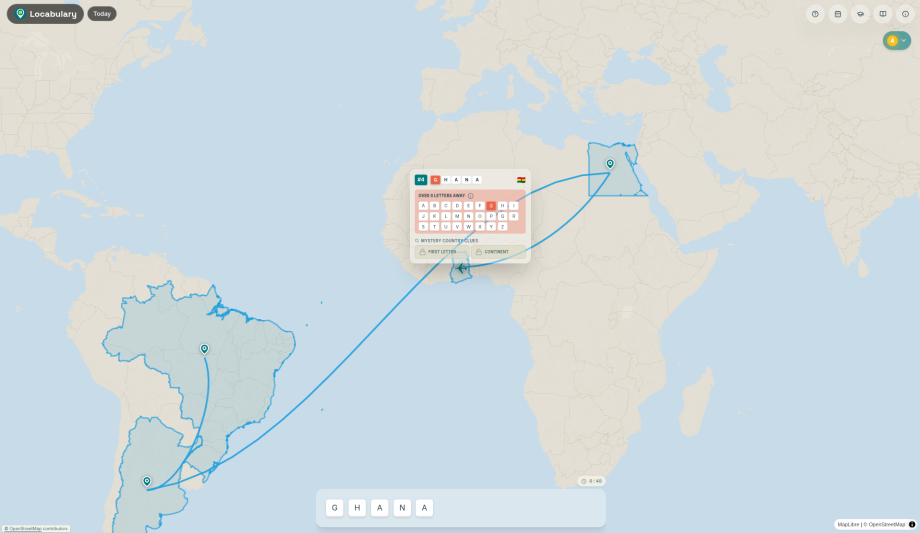
You can try this: start one lesson a week with a 3-question quiz, and go over the answers straight away.
Why Locabulary does this
For classes, we designed it as a 5-minute warm-up on one shared screen, so it can fit at the start of a lesson.
4. Give feedback on the answer itself
A meta-analysis of feedback brought together 435 studies. It found a medium effect of feedback on student learning, but feedback did not work as one single treatment, and the information in the feedback changed the impact.
You can try this: after a student answers, tell them one specific thing about that answer before they try again.
Why Locabulary does this
Every guess gets feedback straight away: a closeness band shows whether its starting letter is within 2 letters, within 6 letters, or over 6 away from the mystery country’s.
5. Use games that are designed for learning
Games can help, and the design matters.
A meta-analysis of digital games and learning looked at students from school to university. It found that digital games improved learning compared with non-game lessons. It also found that the effect changed with the game’s design, and that better-designed games gave extra benefit.
You can try this: before you use a game, ask what students have to recall or decide each time they play.
Why Locabulary does this
Each turn asks players to decide something: which letter of the current country to follow, and which country to try next. The closeness bands and later clues give them something to reason with, and the fewer countries in the chain, the better the score.
Pick one trick to start
You don’t need all 5 at once. Choose the one that fits your next lesson, and try it for 2 weeks.
Ready for today’s mystery country?
Play Locabulary